Last updated: December 23, 2025
How to brief Bangladesh denim factory teams the right way is the difference between a clean 1–2 sample cycle and weeks of delays. This buyer-first playbook gives you a factory-ready brief for woven and denim—tech pack, BOM, approvals, sampling, QC/AQL, packaging, Incoterms, and copy-paste templates you can send today.
Key takeaways (save 60 seconds)
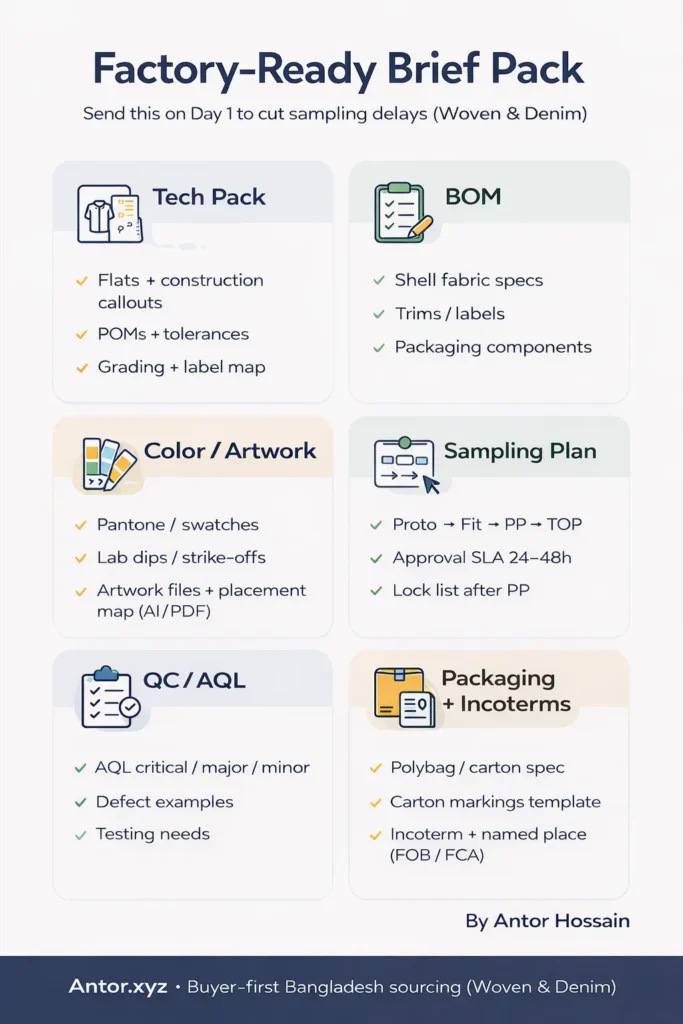
- Send a complete brief on Day 1: tech pack + BOM + standards + packaging + Incoterm.
- Lock approvals in the right order: color/print/wash → PP sample → bulk.
- Define QC early: AQL levels + defect examples = fewer disputes.
- Packaging and carton markings can delay shipments—include them in the brief, not “later.”
- Version control prevents chaos: one file owner, one comment sheet, clear naming.
Table of Contents
- Quick Start: what to send in the first email
- The Factory-Ready Brief Pack (Tech Pack + BOM + Decision Pack)
- Woven vs Denim: what must be different
- Approvals: lab dips, strike-offs, denim wash
- Sampling roadmap + what each stage “locks”
- Simple TNA (Time & Action) that actually works
- Pre-Production Meeting (PPM) checklist
- Quality: AQL + defect language buyers and factories share
- Testing: what to request (and when)
- Packaging & labeling: avoid shipment holds
- Incoterms: define responsibility early
- Communication & version control (world-class workflow)
- Copy-paste templates (RFQ, follow-up, sample comments)
- Next step: Send your brief (RFQ)
- FAQ
How to brief bangladesh denim factory: Quick Start checklist
Copy this checklist, attach your tech pack + BOM, and you’ll cut follow-up questions dramatically.
If you only have 15 minutes, send this “minimum viable brief” pack. It’s enough for serious costing and a clean first sample.
- Tech pack PDF (flats, construction, POMs+tolerances, grading, colorways)
- BOM (fabric, trims, labels, packaging)
- Color/print/wash standards (Pantone/swatches, artwork files, wash reference)
- Target order quantity (even an estimate + size ratio)
- Target FOB range (or say “open costing”)
- Ship window (target ex-factory date)
- QC expectation (AQL levels + any non-negotiables)
- Incoterm + named place (FOB/FCA/etc.)
Buyer-first rule: Factories move faster when they are not forced to guess. Your brief removes guessing.
The Factory-Ready Brief Pack (send on Day 1)
A factory-ready brief is a single source of truth the factory can use to cost, sample, and execute without assumptions.
1) Tech pack (your blueprint)
Your tech pack should answer: What is it? How is it constructed? How do we measure it? What materials are used? What are the approvals?
Tech pack checklist
- Tech flats: front/back + inside views if needed
- Construction callouts: seams, stitch type, seam allowance, SPI guidance, reinforcements
- POMs (Points of Measure): where/how to measure, with diagrams
- Tolerances: acceptable variation per key POM
- Grading: base size + grade rules (or a grade table)
- Colorways: list + reference standards
- Label placement map: main/size/care/country of origin (as needed)
Example POM list (use as a QA check)
Woven shirt POM examples: chest 1″ below armhole, shoulder, sleeve length, bicep, cuff opening, collar point, collar stand height, front length, sweep, placket width, pocket position.
Denim jeans POM examples: waist, high hip/low hip, front rise, back rise, thigh, knee, leg opening, inseam, outseam, yoke height, pocket opening, waistband height.
2) BOM (Bill of Materials): your production recipe
A BOM is the complete list of everything needed to make the garment—including trims, labels, and packaging—so nothing becomes a last-minute blocker.
BOM checklist
- Shell fabric: composition, GSM/oz, weave, finish, shrinkage expectation
- Secondary materials: lining, pocketing, fusing/interlining
- Trims: zipper/buttons/rivets/hardware (finish + color)
- Thread: type (poly/cotton core-spun), ticket number if you use it
- Label set: main/size/care/country of origin as required
- Packaging: polybag spec, size sticker placement, carton spec, carton marking fields
3) Decision Pack (what factories need to quote correctly)
- Target FOB range (or confirm “open costing”)
- Order quantity + color/size split (even estimated)
- Ship window (target ex-factory date)
- Compliance needs (only what your buyer/market requires)
- Incoterm + named place (FOB Chattogram / FCA Dhaka, etc.)
Factory-Ready Checklist (quick table)
| Item | What to include | What it prevents |
|---|---|---|
| Tech pack | Flats, construction notes, POMs+tolerances, grading, colorways | Extra sample rounds due to unclear specs |
| BOM | Fabrics, trims, labels, packaging (with specs) | Missing components at bulk start |
| Standards | Color/print/wash standards + approval method | Approval loops with vague feedback |
| QC | AQL levels + defect examples + any “zero tolerance” items | Inspection disputes + rework |
| Packaging | Polybag/carton spec + carton markings template | Repacking / shipment holds |
| Incoterms | Incoterm + named place + who books freight/docs | Late-stage logistics confusion |
Woven vs Denim: what must be different in your brief
Woven (shirts, dresses, workwear)
- Fusing/interlining: where used + stiffness expectation (collar/placket/cuff)
- Placket/collar/cuff specs: widths, shapes, edge stitching, button spacing
- Stitch + seam clarity: SPI guidance, seam type, reinforcements
- Dimensional stability: how you want garments measured and any shrinkage limits
- Critical details to call out: pocket placement, collar roll, buttonhole length/density, cuff opening
Denim (jeans, jackets, chinos with wash)
- Fabric: oz/yd², stretch %, recovery expectation
- Wash intent: rinse/enzyme/stone/bleach/tint/overdye + reference photos
- Shade tolerance: define acceptable variation (shade band)
- Hardware exactness: rivet/button finish changes the look—spec it clearly
- Risk to address: shade migration, crocking/rub-off, skew, shrink after wash
Approvals: lab dips, strike-offs, denim wash (where weeks disappear)
Lab dips (solid color approval)
A lab dip is a dyed swatch submitted for color approval before bulk dyeing. Approvals go faster when the standard is clear and feedback is specific.
Lab dip approval tips
- Provide a clear standard (Pantone code or physical swatch)
- Specify how you judge: daylight/lightbox preference
- Feedback like “too red / too dull / too dark” is actionable; “not ok” is not
Strike-offs (print approval)
A strike-off is a printed fabric sample used to approve print appearance before bulk printing. Always confirm scale, placement, and color.
Strike-off pack (send together)
- Artwork files: AI/PDF + hi-res PNG
- Placement map with measurements from reference points
- Color standard (Pantone or swatch)
- Approval criteria: scale tolerance + placement tolerance
Denim wash approvals (wash + shade + handfeel)
Denim requires a “look” approval. Lock wash intent early so bulk doesn’t drift.
- Provide 2–4 reference photos (front/back + detail)
- Approve a wash standard: shade band + handfeel expectation
- Confirm whether whiskers, scraping, spray, or tinting is allowed
Sampling roadmap + what each stage “locks”
Sampling works when each stage locks a specific risk—then you stop changing that risk later.
| Sample stage | What it’s for | What should be locked |
|---|---|---|
| Proto | Visualize design intent | Overall silhouette, key construction approach |
| Fit | Fit balance + measurements | POM method + key measurements + fit comments |
| PP (Pre-Production) | Readiness for bulk | Final fabric/trims, approved standards, packaging, QC plan |
| TOP | Early bulk consistency | Bulk performance matches approved sample |
World-class sample comments (reduce email loops)
- One comment sheet (Google Sheet or PDF) with: issue, photo reference, required action, priority, owner, due date.
- Use “must change” vs “nice to have.” Factories move faster when priorities are clear.
- Keep a “locked items list” after PP approval. Any change after that should note cost/time impact.
Simple TNA (Time & Action) that actually works
You don’t need a complicated calendar. A simple “Week-by-week” plan is enough to protect ship date.
| Week | Buyer action | Factory action | Dependency |
|---|---|---|---|
| Week 1 | Send brief pack + standards | Costing + sample plan + questions list | Complete tech pack + BOM |
| Week 2 | Return comments fast | Proto/fit sample development | Clear feedback + decisions |
| Week 3 | Approve standards (color/print/wash) | Material booking + PP prep | Approved standards |
| Week 4 | Approve PP sample + packaging | Bulk start + inline QC plan | PP approval |
Speed lever: Your response time is part of lead time. Returning comments quickly is the cheapest way to ship on time.
Pre-Production Meeting (PPM) checklist
A PPM prevents “surprises” right before bulk. This is where you align on the final version of everything.
PPM agenda (buyer version)
- Confirm final tech pack version + closure of comments
- Confirm approved lab dips / strike-offs / wash standard
- Confirm fabric & trims in-house dates
- Confirm PP sample approval + golden sample handling
- Confirm QC plan: inline checks + final inspection
- Confirm AQL levels + defect examples (critical/major/minor)
- Confirm packaging/carton markings + label rules
- Confirm Incoterm + named place + who books freight/docs
- Set response SLA (who answers within 24 hours)
Quality: AQL + defect language buyers and factories share
AQL in plain language
AQL (Acceptance Quality Limit) is an inspection approach that sets acceptable defect levels in a sampled inspection lot, often classified as critical / major / minor. Many brands align sampling plans with ISO 2859-1 or ANSI/ASQ Z1.4, but your exact levels should match your buyer requirements.
What to include in your brief (minimum)
- Your AQL levels (critical/major/minor)
- “Zero tolerance” issues if any (e.g., needle damage, wrong labeling, safety hazards)
- Defect examples for your product (so classification is consistent)
Example defect language (use and edit)
- Critical: safety hazard, sharp object, contamination, severe damage
- Major: open seam, wrong measurement beyond tolerance, wrong label, obvious shade mismatch, broken zipper
- Minor: small thread ends, minor puckering within tolerance, slight print misalignment within tolerance
Testing: what to request (and when)
Testing should match your product risk and target market. Keep it simple: request only what matters for your buyer.
Common tests buyers request (by risk)
| Risk | Typical focus | Best time to request |
|---|---|---|
| Shrink / size drift | Dimensional stability after wash | Before PP approval / before bulk |
| Color fastness | Wash, rubbing (crocking), perspiration | Before bulk (especially denim/dyed goods) |
| Construction strength | Seam strength, attachment strength (buttons) | PP stage / early bulk checks |
| Appearance | Pilling, spirality, skew (category-dependent) | Development stage if risk is high |
Tip: If your buyer has a vendor manual, follow that. If not, agree “must-pass” tests in the PPM.
Packaging & labeling: avoid shipment holds
Packaging is one of the most common “last-week surprises.” Put it in the brief from Day 1.
Packaging checklist
- Packing method: flat pack / hanger pack
- Polybag: thickness, warning text if needed, size sticker placement
- Carton spec: carton size limits, max weight target, qty per carton
- Carton markings template: PO, style, color, size, qty, carton no., country of origin
- Label rules: care/country of origin/size/brand as required
Carton marking example (edit to your format)
PO: ____ Style: ____ Color: ____ Size: ____
Qty/ctn: ____ Carton no.: ____ of ____ Made in: Bangladesh
Incoterms: define responsibility early
Incoterms clarify tasks, costs, and risk between buyer and seller. Use them to remove confusion before shipping discussions start.
What to specify
- Incoterm + named place: e.g., FOB Chattogram / FCA Dhaka
- Who books freight: buyer vs seller
- Who handles documents: invoice, packing list, export support requirements
- Ship method: sea/air/courier (for samples)
Communication & version control (world-class workflow)
Most delays are communication failures, not manufacturing failures. Use this workflow and your factory will move faster.
1) Version control that prevents chaos
- One file owner (buyer side)
- One comment sheet (single source for feedback)
- One naming system:
STYLE123_TechPack_v07_2025-12-23.pdfSTYLE123_BOM_v03_2025-12-23.xlsxSTYLE123_SampleComments_Fit1_2025-12-23.pdf
2) Response SLA
- Factory questions answered within 24 hours (ideal)
- Sample comments returned fast (your speed = lead time)
3) Locked items list (after PP approval)
- Final fabric + trims
- Approved standards (color/print/wash)
- Packaging + carton markings
- QC/AQL plan
Copy-paste templates (RFQ, follow-up, sample comments)
Template A: RFQ / factory brief message
Subject: Factory Brief — [Style Name] / [Woven Shirt or Denim Jean] — Target Ship [Date]
1) Product
Category: [ ]
Fit: [slim/regular/relaxed] + target market [EU/US/UK/etc.]
Season/use: [workwear/fashion/basic]
2) Order & targets
Estimated order qty: [ ] pcs (initial) + repeat potential
Sizes + ratio: [ ]
Target FOB: [ ] (or “open costing”)
Target ex-factory / ship window: [ ]
3) Tech pack
Attached: Tech pack v[ ] dated [ ]
Base size: [ ]
Tolerances: [ ]
Grading: [attached / to confirm]
4) Fabric
Shell fabric: composition / GSM or oz / weave / finish
Shrinkage expectation/limit: [ ]
Colorways: [list]
5) BOM (trims, labels, packaging)
BOM attached: yes/no
Hardware details (if denim): finish/color references [photos/links]
6) Color / artwork
Lab dip required? yes/no — Standard: [Pantone / swatch]
Print? yes/no — Strike-off required? yes/no
Artwork files attached: AI/PDF + placement map
7) Denim wash (if denim)
Wash intent: [rinse/enzyme/stone/bleach/tint/overdye]
Target shade range: [ ]
Handfeel expectation: [ ]
Wash approval required: yes/no
8) QC & testing
AQL: Critical [ ], Major [ ], Minor [ ]
Key tests: [shrinkage, colorfastness, rubbing/crocking, etc.]
Inspection: [inline/final/3rd party if any]
9) Packaging
Packing method: [flat/hanger]
Polybag: [spec] + size sticker placement [ ]
Carton: max weight target [ ] kg; carton markings template attached: yes/no
10) Shipping
Incoterm + named place: [ ]
Destination: [city/country]
Documents needed: [invoice, packing list, etc.]
11) Next steps
Please confirm within 24–48h:
1) Costing + MOQ assumptions
2) Sample timeline (proto → fit → PP → TOP)
3) Fabric/trims lead-time risks
4) Questions list (single document)
Template B: Follow-up (when factory is slow)
Subject: Follow-up: [Style] — please confirm costing + sample plan
Hi [Name],
Following up on the attached brief for [Style]. Please confirm:
1) Estimated FOB with MOQ assumptions
2) Sample timeline (proto/fit/PP)
3) Any missing inputs you need from us
We can reply to questions within 24 hours to keep the timeline moving.
Thanks,
[Your Name]
Template C: Sample comments (fast and clean)
Subject: Sample Comments — [Style] — [Proto/Fit/PP] — v[ ]
Hi [Name],
Please find attached the single comment sheet with photos and required actions. Priority items are marked “MUST.”
Kindly confirm updated sample submission date once changes are implemented.
Thanks,
[Your Name]
Next step: Send your brief (RFQ)
Send your tech pack + brief and we’ll route it to compliant Bangladesh partners for your product category:
Free download: Tech Pack Checklist
Related reading
- MOQ & Pricing in Bangladesh Woven & Denim Garments
- Bangladesh Woven & Denim Sourcing Guide 2026
- Bangladesh vs China vs Turkey for Woven & Denim
External references (for buyers)
- Incoterms® rules — International Chamber of Commerce (ICC)
- ISO 2859-1 overview — acceptance sampling indexed by AQL
- ANSI/ASQ Z1.4 — sampling procedures for inspection by attributes
FAQ
What’s the minimum I should send for costing?
Send a tech pack (flats + construction + POMs + tolerances) plus a BOM (fabric/trims/labels/packaging) and your estimated order quantity + ship window. Without these, costing becomes guesswork.
Lab dip vs strike-off: what’s the difference?
A lab dip is for solid color approval before bulk dyeing. A strike-off is for print approval before bulk printing.
What is a PP sample?
A pre-production (PP) sample is made with final materials and trims to confirm readiness before bulk manufacturing.
What is AQL and why does it matter?
AQL sets acceptable defect levels in a sampled inspection lot (critical/major/minor). It reduces inspection disputes because acceptance criteria are agreed in advance.
Do I need to include packaging in the first brief?
Yes. Packaging and carton markings are common causes of last-week delays. Including them early prevents repacking and shipment holds.
Note: This guide is educational and does not replace your buyer contract, technical standards, or required shipping documentation.
One Response