Buyer guide: Bangladesh product strengths by apparel category should be understood before any buyer sends an RFQ, asks for a factory quote, or starts supplier shortlisting. Bangladesh is one of the strongest apparel sourcing destinations in the world, but buyers should not treat every supplier as if they can make every product equally well.
A knitwear factory, woven factory, denim factory, sweater factory, outerwear factory, uniform factory, and workwear factory do not operate the same way. Each category has different machinery, operators, technicians, material sourcing realities, approval steps, MOQ logic, and quality risks.
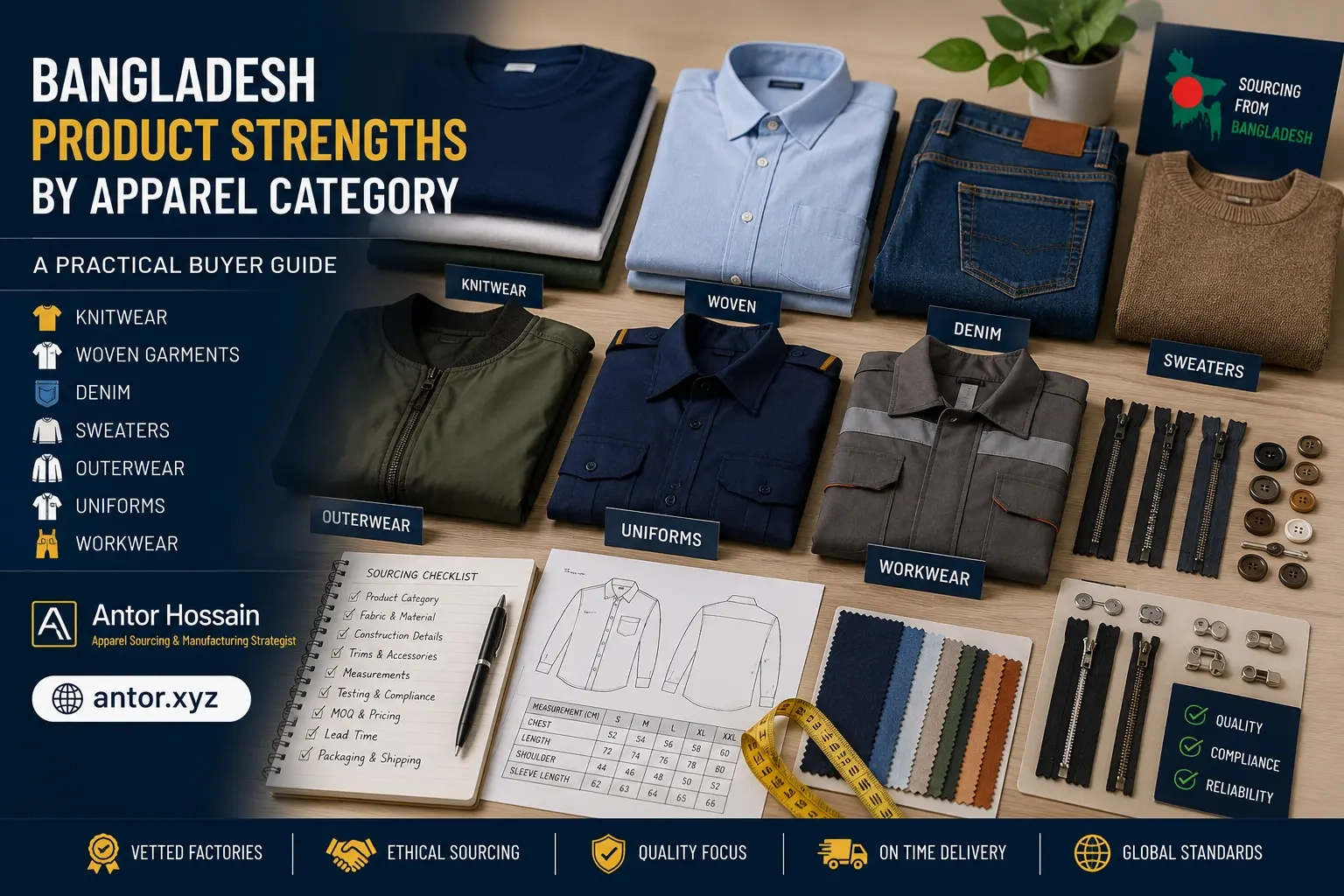
This is why product-to-supplier matching should happen before price comparison. A low quote from the wrong factory can create expensive problems later: slow sampling, unclear costing, weak fit, wrong fabric, failed testing, shade variation, shipment delay, or quality claims.
Who this guide is for
This guide is written for fashion brand founders, sourcing managers, importers, wholesalers, private label teams, retailers, and merchandisers who want to shortlist Bangladesh suppliers more carefully before sending inquiries.
It is especially useful if you are sourcing or planning to source T-shirts, polo shirts, woven shirts, trousers, denim jeans, jackets, sweaters, uniforms, workwear, kidswear, or private label apparel programs from Bangladesh.
What you will learn
- Why Bangladesh should not be treated as one supplier type.
- Which apparel categories Bangladesh is commonly strong in.
- What buyers should check before sending an RFQ.
- How knit, woven, denim, sweater, outerwear, uniform, and workwear suppliers differ.
- Why factory-fit matters as much as FOB price.
- How to reduce quotation errors, sampling delays, and bulk production risk.
TLDR buyer checkpoints
| Buyer question | Why it matters |
|---|---|
| What is the exact product category? | It decides the right supplier type. |
| Is the fabric knit, woven, denim, sweater yarn, or technical material? | Fabric type affects machines, sourcing time, shrinkage, approval, and cost. |
| Is the style basic, fashion, or technical? | Complexity changes factory-fit and QC risk. |
| Does the garment need wash, print, embroidery, coating, or special finishing? | Finishing can affect lead time, shade, measurement, hand feel, and approval. |
| What quantity and color split are realistic? | MOQ is not only total quantity. It depends on fabric, trims, colors, sizes, and production setup. |
| What compliance or testing is required? | Factory selection should include audit, safety, testing, and documentation needs. |
| Is the timeline realistic? | Sampling, material booking, approvals, production, inspection, and shipment all need time. |
Source discipline note
This article uses public industry references for Bangladesh RMG export context, factory scale, and compliance ecosystem. Export values and market shares can change, so buyers should always check the latest official or industry data before using numbers in commercial decisions.
The practical message is more important than one number: Bangladesh has large apparel capacity, but supplier selection must still be product-specific, compliance-aware, and commercially realistic.
Bangladesh apparel sourcing in context
Bangladesh is a major ready-made garment sourcing base for global fashion brands, retailers, importers, and private label businesses. The country has deep export experience across knitwear, woven garments, denim, sweaters, casualwear, uniforms, and other apparel categories.
Bangladesh also has a large supporting ecosystem: fabric mills, washing plants, trims suppliers, embroidery units, printing facilities, testing support, logistics providers, merchandising teams, and production follow-up professionals.
But scale alone does not remove sourcing risk. A large apparel country can still be the wrong match for a specific product if the buyer chooses the wrong factory type.
- A basic T-shirt factory may not be right for a structured woven jacket.
- A woven shirt factory may not be right for denim jeans with heavy wash effects.
- A denim supplier may not be right for fine-gauge sweaters.
- A uniform factory may not be right for lightweight fashion dresses.
- A small flexible unit may not be right for a large retail program.
- A high-volume factory may not be interested in a fragmented low-quantity order.
The better question is not only, “Can Bangladesh make this product?” The better question is, “Which Bangladesh supplier type is right for this product, quantity, quality level, compliance requirement, and timeline?”
Why product-to-supplier matching matters
Good apparel sourcing does not start with a quotation. It starts with a fit check.
When a buyer sends an incomplete inquiry to the wrong supplier, the factory may still quote. But that quote may be based on assumptions. Those assumptions can later become price revisions, sample delays, fabric substitutions, wash problems, weak measurement control, unclear MOQ, or shipment risk.
The buyer may think the factory failed. Sometimes the factory did fail. But often the sourcing process failed earlier because the product was not matched with the right supplier type.
1. Knitwear and everyday basics
Bangladesh is especially strong in knitwear and everyday apparel basics. Common knitwear programs include T-shirts, polo shirts, tank tops, sweatshirts, hoodies, joggers, leggings, basic kidswear, loungewear, and everyday casualwear.
Knitwear can be a strong fit for volume programs, repeat orders, promotional styles, private label essentials, and price-sensitive categories. But buyers should not assume every knit item is simple.
A basic T-shirt can still go wrong if the buyer does not define fabric composition, GSM, yarn count, shrinkage requirement, measurement tolerance, print quality, embroidery placement, color standard, packing method, and wash requirement.
What makes knitwear sourcing different
- Fabric composition.
- GSM.
- Yarn count.
- Fabric construction.
- Shrinkage percentage.
- Spirality.
- Color fastness.
- Print or embroidery technique.
- Neck rib quality.
- Measurement stability after wash.
- Packing and folding standard.
A buyer may ask for a 180 GSM cotton T-shirt, but that is still not enough for accurate development. The factory may need to know whether the buyer wants single jersey, combed cotton, compact yarn, enzyme wash, bio polish, silicone finish, neck tape, side seam, tubular body, or specific shrinkage tolerance.
Buyer checkpoint: Knitwear sourcing works best when the buyer gives clear fabric, construction, measurement, color, finishing, packaging, and testing details from the beginning.
2. Woven garments
Bangladesh is also strong in woven garments, especially shirts, bottoms, casualwear, dresses, and commercial fashion programs. Common woven products include shirts, blouses, trousers, chinos, shorts, dresses, skirts, casual jackets, light outerwear, woven kidswear, uniform shirts, and uniform pants.
Woven sourcing requires more attention to fabric behavior, fit, construction, trims, seam quality, shrinkage, wash effect, and finishing standard.
What makes woven sourcing different
- Fabric type and weight.
- Shrinkage after wash.
- Weave structure.
- Pocket construction.
- Collar and cuff construction.
- Waistband quality.
- Button and zipper quality.
- Interlining selection.
- Seam allowance.
- Stitch density.
- Pressing and finishing standard.
- Measurement tolerance.
A woven shirt may look simple, but the final quality depends on collar shape, front placket, sleeve setting, cuff balance, button placement, hem curve, stitching cleanliness, and pressing. A trouser or chino adds more complexity because the waistband, fly, pocketing, belt loops, back rise, inseam, outseam, and fit balance must be controlled carefully.
For a deeper woven and denim sourcing view, see the related guide: Bangladesh Woven and Denim Sourcing Guide 2026.
Buyer checkpoint: Woven sourcing works best when fabric, fit, construction, trims, wash, measurements, and approval process are clearly defined before sampling starts.
3. Denim
Bangladesh has strong denim capability, but denim sourcing needs disciplined development control. Common denim programs include jeans, denim jackets, denim shorts, denim skirts, denim shirts, basic denim bottoms, fashion denim styles, and washed denim programs.
Denim is different from many apparel categories because wash and finishing can change the final appearance, hand feel, shade, measurement, and buyer acceptance.
The same denim fabric can look very different after rinse wash, enzyme wash, stone wash, bleach effect, whisker, scraping, grinding, tinting, ozone treatment, laser effect, or other finishing processes.
What makes denim sourcing different
- Fabric weight and stretch.
- Shrinkage behavior.
- Wash recipe.
- Shade band.
- Hand feel.
- Measurement after wash.
- Pocketing quality.
- Rivets, buttons, zippers, and labels.
- Color fastness.
- Seam puckering.
- Bulk shade consistency.
- Approved standard sample.
- Washing plant capability.
A buyer should not approve denim only from a photo. Physical hand feel, shade, garment measurement after wash, and bulk shade tolerance must be agreed clearly.
Buyer checkpoint: Denim sourcing should not move too fast without approved wash standard, final hand feel confirmation, and measurement control after wash.
4. Sweaters
Bangladesh is also known for sweater programs, including both basic and fashion sweaters. Common sweater products include pullovers, cardigans, basic sweaters, fashion sweaters, fine-gauge sweaters, chunky knit sweaters, school sweaters, uniform sweaters, and knit vests.
Sweater sourcing is different from cut-and-sew knitwear. It requires yarn planning, gauge selection, panel knitting, linking, finishing, washing, and measurement control.
What makes sweater sourcing different
- Yarn composition.
- Yarn count.
- Gauge.
- Stitch type.
- Panel shape.
- Rib structure.
- Neck opening.
- Sleeve shape.
- Linking quality.
- Hand feel.
- Washing and finishing.
- Measurement stability.
- Pilling requirement.
- Color approval.
A sweater can look good in a photo but fail in real use because of poor hand feel, weak recovery, twisting, pilling, uneven linking, neckline distortion, or poor measurement stability.
Buyer checkpoint: Sweater sourcing works best when yarn, gauge, stitch structure, measurement, color, and finishing quality are confirmed early.
5. Outerwear and jackets
Bangladesh can support outerwear and jacket programs, but supplier selection becomes more important as construction complexity increases. Common outerwear programs include lightweight jackets, padded jackets, utility jackets, casual outerwear, denim jackets, work jackets, hooded jackets, and lined jackets.
Outerwear requires stronger technical planning than basic apparel because it often uses multiple materials and components.
What makes outerwear sourcing different
- Shell fabric performance.
- Lining quality.
- Padding weight and distribution.
- Zipper quality.
- Pocket function.
- Seam strength.
- Quilting balance.
- Hood construction.
- Drawcord and stopper safety.
- Needle damage risk.
- Pressing and finishing.
- Performance testing.
Not every woven factory can produce outerwear well. A basic shirt line and a technical jacket line are not the same.
Buyer checkpoint: Outerwear sourcing should be handled with stronger pre-production planning than basic apparel. Buyers should prepare shell fabric, lining, padding, trims, measurements, testing needs, and target delivery before asking for price.
6. Uniforms and workwear
Uniforms and workwear are different from fashion basics because function matters as much as appearance. Common programs include work shirts, work pants, coveralls, utility jackets, security uniforms, school uniforms, corporate uniforms, aprons, safety garments, and industrial workwear.
These categories usually require durability, consistency, and technical discipline. Workwear and uniform buyers often care about long-term wear performance. The garment must survive repeated washing, movement, abrasion, and daily use.
What makes uniforms and workwear different
- Fabric strength.
- Color fastness.
- Seam strength.
- Bartack placement.
- Pocket function.
- Reflective tape quality.
- Zipper and snap durability.
- Size consistency.
- Shade continuity across repeat orders.
- Testing and documentation.
- Packing and replenishment planning.
A buyer should not treat a workwear order like a normal fashion style. The factory must understand function, safety, repeatability, and durability.
Buyer checkpoint: Supplier selection matters more in technical categories. Buyers should check previous experience, machinery, material handling, testing knowledge, QC process, and compliance readiness before moving forward.
Bangladesh product strengths by category
| Category | Common products | Buyer advantage | Main risk if supplier is wrong |
|---|---|---|---|
| Knitwear | T-shirts, polos, sweatshirts, joggers, leggings | Strong volume base, repeat programs, everyday basics | Fabric GSM, shrinkage, print quality, measurement instability |
| Woven | Shirts, trousers, chinos, dresses, shorts | Strong commercial woven capability | Fit, construction, trims, shrinkage, finishing |
| Denim | Jeans, jackets, shorts, skirts | Strong wash and denim ecosystem | Wash mismatch, shade variation, measurement after wash |
| Sweaters | Pullovers, cardigans, school sweaters | Seasonal and fashion knit programs | Gauge mismatch, linking quality, pilling, hand feel |
| Outerwear | Jackets, padded styles, utility jackets | Technical value when supplier-fit is correct | Wrong machinery, weak trims, construction defects |
| Uniforms | Schoolwear, corporate wear, service uniforms | Repeat orders and stable programs | Shade continuity, durability, fit consistency |
| Workwear | Coveralls, utility pants, work jackets | Functional and long-term programs | Failed seam strength, poor durability, weak testing control |
For directional category validation, buyers can also review the Bangladesh RMG Product Strengths Dataset. Use this type of dataset as a planning tool, not as a replacement for supplier capability checks.
What buyers should prepare before sending inquiries
Many buyers ask for price too early. Factories cannot quote accurately from a product photo alone. A serious RFQ should give enough information for the supplier to understand material, construction, quantity, timeline, quality level, and compliance needs.
- Product category: Define whether the product is knit, woven, denim, sweater, outerwear, uniform, or workwear.
- Product photo or reference sample: Use photos as visual support, not as the full specification.
- Tech pack or product sheet: Include construction, measurement, fabric, trims, artwork, labeling, packing, and quality notes.
- Fabric details: Include composition, weight, construction, finish, and any required certification or performance standard.
- Quantity breakdown: Share quantity by style, color, and size if possible.
- Trim and packaging details: Buttons, zippers, labels, hangtags, polybags, cartons, and barcodes can affect price and lead time.
- Wash, print, or embroidery details: Finishing requirements can change costing and development time significantly.
- Compliance and testing requirement: Share audit, testing, restricted substance, and documentation requirements before sampling.
- Target price and delivery window: A target price is useful when realistic. A delivery window is essential for capacity planning.
- Incoterm and shipment expectation: Clarify whether the quotation should be FOB, FCA, CIF, DDP, or another basis.
Buyers preparing an RFQ can also use the Free Tech Pack Checklist and the MOQ Planner for Bangladesh Woven and Denim before contacting suppliers.
Buyer decision gate: Is the supplier fit correct?
| Decision area | Ask this question | Green signal |
|---|---|---|
| Product experience | Has the supplier made this category before? | They can show relevant production experience. |
| Machinery | Does the factory have the right machines and lines? | Machinery matches the construction. |
| Fabric sourcing | Can they source or handle the required fabric? | They understand fabric behavior and lead time. |
| MOQ | Does the order fit their production setup? | Quantity, color split, and style count are practical. |
| Compliance | Can they meet buyer audit and safety requirements? | Documentation is clear and verifiable. |
| Technical team | Can they support sampling and fit comments properly? | Merchandising and technical communication are disciplined. |
| Timeline | Can the factory meet the deadline without shortcuts? | The T&A plan is realistic. |
If the answer is weak in more than one area, do not push the supplier only because the price looks attractive.
Common mistakes buyers should avoid
Mistake 1: Sending the same inquiry to every factory
A supplier list is not a sourcing strategy. Buyers should shortlist by category, capability, compliance, MOQ, and timeline.
Mistake 2: Asking for price from only a photo
A product photo cannot define fabric quality, measurement, trims, construction, testing, packing, or shipping scope.
Mistake 3: Comparing FOB prices without checking assumptions
Two suppliers may quote the same product differently because they assumed different fabric, trims, wash, packing, testing, wastage, or compliance scope. For a deeper pricing explanation, read MOQ and Pricing in Bangladesh Woven and Denim Garments.
Mistake 4: Ignoring MOQ by color
A total order of 5,000 pieces may look practical, but if it is divided into many colors and sizes, fabric and trim MOQ can become a serious issue.
Mistake 5: Treating denim wash as a minor detail
Denim wash can change shade, hand feel, shrinkage, measurement, and final approval. It should be controlled early.
Mistake 6: Choosing a factory before checking compliance
Compliance should not be checked after price confirmation. It should be part of supplier shortlisting.
Mistake 7: Pushing unrealistic timelines
A rushed timeline may create hidden risk in fabric booking, lab dips, sample approval, testing, production, inspection, and shipment.
RFQ readiness checklist
| RFQ item | Ready? |
|---|---|
| Product category defined | Yes / No |
| Tech pack or detailed product sheet | Yes / No |
| Product reference image or sample | Yes / No |
| Fabric composition and weight | Yes / No |
| Construction details | Yes / No |
| Measurement chart | Yes / No |
| Size range and grading | Yes / No |
| Quantity by style, color, and size | Yes / No |
| Trim details | Yes / No |
| Print, embroidery, wash, or finish details | Yes / No |
| Packaging and labeling requirement | Yes / No |
| Testing and compliance requirement | Yes / No |
| Target price or price expectation | Yes / No |
| Target shipment date | Yes / No |
| Required incoterm | Yes / No |
If most answers are “No”, the buyer should improve the brief before asking for final price.
How to shortlist Bangladesh suppliers by category
Step 1: Classify the product
Start by identifying whether the product is knit, woven, denim, sweater, outerwear, uniform, or workwear.
Step 2: Define technical complexity
Separate basic, fashion, and technical products. A basic T-shirt, washed denim jacket, and multi-pocket workwear coverall do not belong in the same supplier search.
Step 3: Match quantity with factory setup
Some factories prefer larger volume programs. Some can support more flexible orders. Some are strong in development but need realistic bulk volume.
Step 4: Check compliance early
Ask for relevant compliance documents, audit status, safety monitoring status, and buyer-specific requirements before moving too far.
Step 5: Test communication discipline
A good supplier should ask useful questions. If a factory quotes quickly without asking about unclear details, the price may be built on assumptions.
When a higher quote may be safer
The cheapest supplier is not always the best supplier. A higher quote may be safer when it includes better fabric quality, more realistic trims, correct wash process, stronger compliance readiness, a better technical team, more accurate production planning, lower risk of late cost revision, better inspection outcome, and clearer communication.
Buyers should compare total sourcing risk, not only unit price. A low FOB price can become expensive if it leads to re-sampling, failed testing, shipment delay, discount demand, air freight, quality claims, or lost selling time.
Final buyer takeaway
Bangladesh has strong capability across knitwear, woven garments, denim, sweaters, outerwear, uniforms, workwear, and private label apparel programs. But Bangladesh sourcing works best when buyers approach the market with discipline.
Do not start with “Who can give me the cheapest price?” Start with better questions:
- What product category am I sourcing?
- What supplier type does this product need?
- What technical details must be clear before price?
- What compliance level is required?
- What MOQ and timeline are realistic?
- What risks should be controlled before sampling?
A knitwear supplier, woven supplier, denim supplier, sweater supplier, and workwear supplier each has a different strength. The buyer’s job is to match the product with the right capability before asking the factory to commit price, quality, and delivery.
That one step can make the entire sourcing process more accurate, more transparent, and more reliable.
Sources and references
- BGMEA – Export Performance
- BGMEA – BGMEA at a Glance
- Better Work Bangladesh – Our Programme
- RMG Sustainability Council – About Us
- Antor.xyz – Bangladesh Woven and Denim Sourcing Guide 2026
- Antor.xyz – MOQ and Pricing in Bangladesh Woven and Denim Garments
- Antor.xyz – Bangladesh RMG Product Strengths Dataset
- Antor.xyz – MOQ Planner
- Antor.xyz – Free Tech Pack Checklist
Last updated: June 23, 2026