MOQ & Pricing in Bangladesh Woven & Denim Garments
How factories really think about quantity, FOB and “Bangladesh price”
Who this article is for Buyers planning woven shirts, chinos and denim programs out of Bangladesh for 2026–2027 who want realistic MOQ and price expectations — not fantasy quotes that collapse at bulk.
Quick summary (for busy sourcing leads)
MOQ is not one number. Different factories in Bangladesh sit anywhere from a few hundred pieces for specialized makers to 1,000–3,000+ pcs per style/color for larger woven & denim units.
Fabric + wash drive most of the FOB. In shirts, woven bottoms and denim, fabric alone is often around half of the garment FOB, with trims a small single-digit percentage; the rest is CM, overheads, washing, testing, finance and margin.
Small orders cost more per unit. Because set-up and development costs are spread over fewer pieces, very small runs usually have a higher unit price than mid or core volumes – this is just basic economies of scale, not “overcharging”.
At the end of this article you’ll find two practical next steps:
Start a Woven Shirt RFQ (Bangladesh)
Start a Denim Jeans RFQ (Bangladesh)
…and a link to a free Tech Pack Checklist if you’re still cleaning up data.
1. Why MOQ and price feel confusing in Bangladesh
If you talk to three different factories in Bangladesh about the same woven shirt or denim jean, you might hear three very different MOQ answers:
“We need 3,000 pcs per color.”
“We can do 500 pcs per color for private label.”
“We can look at 200 pcs, but price will be high.”
All of them can be telling the truth for their own business model.
Across the industry you’ll find:
Larger exporters who set MOQs of around 1,000–3,000+ pcs per style/color to keep lines efficient and overheads covered.
Smaller or specialised manufacturers who sometimes accept 50–500 pcs per design/colour, but with a noticeably higher price per unit.
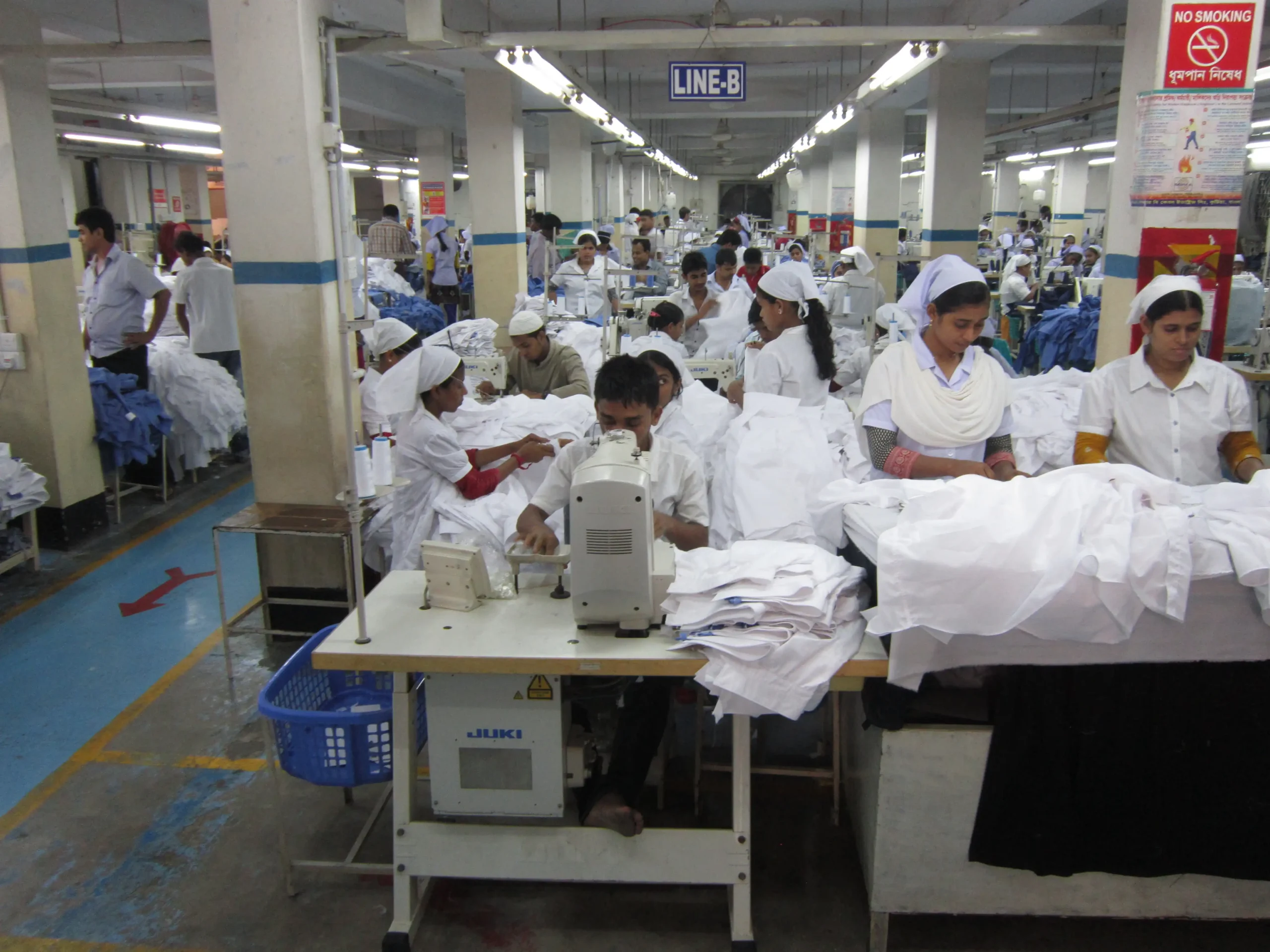
At the same time, Bangladesh is now one of the most important global apparel exporters, and a major hub for denim and woven bottoms. Many brands come in expecting:
“Low MOQ + low FOB + fast lead time… because Bangladesh is cheap and huge.”
Factories, meanwhile, are thinking about:
Fabric ordering and MOQs from mills
Marker efficiency and cutting plans
Line efficiency, washing capacity, compliance, finance and risk
This article is written to bridge that gap, specifically for:
Woven shirts & blouses
Woven bottoms (chinos, casual trousers)
Denim jeans & casual denim
Knits are secondary here and only referenced for comparison.
2. The three MOQ bands I actually work with
Instead of chasing one “magic” MOQ, it’s more practical to use three quantity bands when placing woven & denim programs in Bangladesh.
These are not “official Bangladesh MOQs”. They are working bands that map well to how many woven/denim factories here run their business.
2.1 Quantity bands – overview
Band
Typical range (pcs/color)
Best use case
What to expect on price
Test / SMU
50–300
New fits, capsule collections, influencer/online tests, color & wash testing
Highest cost per unit; treated as R&D. Price is more like a lab or sample room than a full production run.
Growth zone
300–1,800
New styles in an existing program, broader seasonal range, new channels
Healthy balance of flexibility and efficiency. Price starts to look like a “normal” FOB, especially from 600–800 pcs upwards.
Core program
2,000+
Proven fits and washes that you repeat every season; key value and mid-market lines
Best pricing, highest priority for capacity, and more leverage to ask for development support and calendar flexibility.
These bands sit comfortably inside what many Bangladesh factories already do:
Larger woven & denim exporters often prefer 1,000–3,000+ pcs per style/color.
Specialist or smaller manufacturers may go down to 50–500 pcs, but the unit price is higher to cover fixed costs and risk.
2.2 How this looks by category
Woven shirts (yarn-dyed, solids, prints)
Tests (50–300 pcs/color)
New fits, linings or fabric stories.
Treat these as learning cost, not your long-term price.
Growth (300–1,800 pcs/color)
Good for seasonal check programs, updates on a core block, or channel-specific variants.
Many woven factories in Bangladesh are comfortable in this band when there is a realistic repeat plan.
Core (2,000+ pcs/colour)
Classic oxfords, poplins or twills in key colours for value/mid-market retailers.
This is where Bangladesh’s woven strengths really show, especially with good marker efficiency and mill relationships.
Denim jeans
Tests (50–300 pcs/color/wash)
New fits, wash identities, or campaign capsules.
The washhouse and factory do almost the same development work as for bigger volumes, so per-unit FOB is higher.
Growth (300–1,800 pcs/color/wash)
Adding new silhouettes into an existing program (wide leg, loose fits, new rises).
With reasonable volumes and clear wash briefs, Bangladesh denim factories can be very competitive on FOB.
Core (2,000+ pcs/color/wash)
Bread-and-butter 5-pocket jeans and key washes that repeat season after season.
Integrated mills + washing plants + garment units deliver strong economies of scale here.
3. What really drives FOB for woven & denim
Most buyers know that FOB is more than fabric + CM, but still underestimate how many components go into a realistic quote.
3.1 FOB price – what’s inside
A typical FOB garment cost will include:
Fabric cost
Trims & accessories
Cut, Make, Trim (CMT) – labour and factory overhead
Washing / finishing (especially for denim)
Packing & cartons
Testing & compliance
Documentation & inland freight to port
Finance, overhead and profit
Industry studies on shirts, trousers and denim consistently show:
Fabric often accounts for around half (or slightly more) of FOB in mass-market apparel.
Trims usually contribute a small single-digit percentage of FOB.
So if you ask a Bangladesh factory to reduce FOB significantly without touching fabric, wash or trims, they are usually being asked to squeeze an already thin CM & overhead margin — which often leads to trouble later (quality, service or capacity).
3.2 Fabric decisions that move price
For woven shirts, chinos and denim, the biggest levers are:
Fibre & yarn type – cotton vs blends, ringspun vs open-end, special slubs
Weight & weave – e.g., 118 gsm poplin vs 160 gsm oxford vs 12 oz denim
Finishes – easy-care, peach, special coatings, yarn-dye complexity
Raw material (fabric) is usually a large share of total garment cost in mass-market apparel, so small decisions here have big price implications.
3.3 Wash & finishing (especially for denim)
For denim, washing is a major cost and risk driver:
Basic rinse or enzyme
Medium wash with whiskers and subtle abrasion
Heavy vintage looks, tinting, local sprays, 3D work, resin, etc.
Modern laundries in Bangladesh increasingly use laser, ozone and low-liquor systems to control both impact and cost, but those machines still need time, specialists and regular R&D. More complex washes require more processes, testing and approvals — and therefore more cost.
Branded hardware, recycled labels, special hangers, intricate cartons
Compliance & testing
Chemical and safety standards (EU, US, UK etc.) add tests, paperwork and process cost
The more “story” you load into a garment without matching it with volume and price architecture, the harder it is to keep FOB realistic.
4. How small vs large MOQ changes your unit cost
Rather than inventing a single “Bangladesh price”, it’s more honest to think in scenarios.
Note: The examples below are illustrative, based on standard costing logic. They are not quotes and not a promise of what your FOB will be.
4.1 Woven shirt – same spec, different quantities
Assume you keep:
Same fabric (for example, 100% cotton yarn-dyed check)
Same make (pockets, construction, buttons)
Same compliance & testing
But only change quantity:
200 pcs per color
The factory still needs a full pattern, markers, line setup, trims booking, finishing and QA.
Fixed costs are spread over very few units.
1,000 pcs per color
Markers run longer, fabric utilisation improves and line efficiency improves.
3,000+ pcs per color
You are close to big-program economics; fabric booking is smoother, and factories can pass some efficiency into FOB.
It is normal for the smallest band to have a noticeably higher FOB than the largest band for the same spec, because:
Marker losses hit harder at low volume
CM, overhead and QA do not scale down linearly
Factories must price in capacity risk and extra sampling
4.2 Denim jean – same fit & wash, different quantities
Take a basic 5-pocket denim jean:
Same denim fabric
Same medium wash with whiskers & hand-sand
Same trims & packaging
In real costing sheets, fabric and washing together can represent a large share of total FOB. If you run:
150 pcs per color/wash
Lab and bulk wash development, shade approvals and setup costs are spread over very few units.
900 pcs per color/wash
Wash development and setup are amortised over more volume; per-unit impact is lower.
2,400+ pcs per color/wash
Wash R&D is tiny relative to the run; you’re paying mostly for fabric, trims and true variable cost.
This is why factories in Bangladesh (and other hubs) push you to either:
Commit to volume on a core block and negotiate on FOB, or
Accept that fashion capsules and micro runs come at a premium per unit.
5. Common MOQ & price mistakes buyers make in Bangladesh
5.1 Comparing FOB vs ex-factory
You can’t fairly compare:
Bangladesh FOB (fabric + trims + CM + overhead + local logistics to port + margin)
With another country’s ex-factory or CMT price (often excluding key components)
Always make sure you’re comparing like with like when you benchmark quotes.
5.2 Expecting sample prices to match bulk FOB
Sample and proto runs:
Use much shorter markers
Have heavy pattern and QA time
Are often executed when line space frees up between bulk runs
Any “per piece” cost you see at SMS or photo sample stage is indicative only, not your final FOB.
5.3 Loading too much complexity into tiny orders
Typical example:
150 pcs per wash, but with:
Complex multi-stage dry process
Expensive branded metal hardware
Recycled and certified trims
Hangers, special polybags and custom cartons
…and a target FOB aligned with a value-market retail price.
On paper, the garment looks simple. In reality you’re asking the factory and washhouse to invest disproportionate R&D, admin and risk for almost no volume leverage.
5.4 Treating Bangladesh as a “last-minute chaser”
Because Bangladesh is a huge exporter, buyers sometimes think they can:
Move in late
Demand extremely tight lead times
Push for low prices on complex woven/denim styles
Bangladesh’s strength is in well-planned programs where mills, laundries and factories can plan fabric, washing and capacity. Ultra-urgent, fragmented orders usually belong in near-shore hubs (for example Turkey, Eastern Europe, Mexico), even if nominal CM or FOB is higher.
6. Where Bangladesh wins on MOQ & pricing – and where it doesn’t
6.1 Strong fits for woven & denim
Bangladesh is structurally strong when you:
Commit real volume (especially 300–1,800 and 2,000+ pcs/color)
Work on shirts, chinos, casual woven bottoms and denim jeans
Accept standard lead times that allow proper planning
Want competitive FOB in value to mid-market price tiers
6.2 Cases where another base may be better
Consider other hubs when:
You need ultra-short lead times with lots of in-season chasing
Your ranges are micro-run luxury or designer with heavy experimentation
You’re dependent on a specific local fabric story (Italian mills, Japanese selvedge, etc.)
In those situations, Bangladesh can still be part of your mix, but not necessarily the main base.
7. How I structure MOQ & price conversations when you submit an RFQ
When you send a woven or denim RFQ, we don’t start with a random “Bangladesh price”. We start with:
Your non-negotiables on compliance, sustainability and testing
At least draft tech packs or design sheets – not just mood boards
If your tech packs are not ready yet, it’s still fine to talk — but we should frame it as feasibility and sourcing strategy, not as a request for final quotes.
9. Ready to talk MOQ & pricing for your program?
You have two clear options:
Option 1 – You’re ready to brief specific products
If you already have a range, volumes and timeline for woven shirts or denim jeans, send it through one of these RFQs:
2 Responses